Sustainability
April 9, 2026
Science-Based Targets Officially Set: SWM’s Decarbonization Roadmap
Validated targets mean nothing without execution. Here is how SWM International is turning its SBTi commitment into measurable progress – at our sites, in our supply chain, and across our entire value chain.
Having secured official SBTi validation (SBTi ID:40013404) for our decarbonization targets, SWM’s focus turns decisively to execution. Our interim target is clear: reduce absolute greenhouse gas emissions across Scopes 1, 2 (-54.6%) and 3 (-32.5%) by 2033. The roadmap to get there is already in motion with parallel actions underway across our global manufacturing sites, procurement function, and supply chain network.
Pillar One: Energy Efficiency at Our Sites
The starting point is our own operations. As part of our Thinpact program, SWM has committed to reducing energy intensity across all global facilities through process optimization, equipment upgrades, and operational discipline. Progress is measured and reported annually. Savings already achieved (-9% 2024 versus 2021) across our sites in France, Poland, Brazil, the United States, demonstrate that energy efficiency is not a future ambition. It is happening now. These improvements reduce both our carbon footprint and our operating costs, reinforcing that sustainability and business performance work together.
Pillar Two: Transitioning to Renewable Energy
Improving energy efficiency reduces what we consume. Renewable energy changes what that consumption is made of. SWM is actively implementing concrete actions, such as on-site generation with a new biomass boiler at the Quimperlé mill and a long-term procurement agreement with TotalEnergies. The objective is to progressively eliminate fossil fuels from our Scope 1 and 2 emissions profile. The approach will vary by geography, but the direction is consistent across every site.
Pillar Three: Transforming the Supply Chain
For a specialty materials manufacturer like SWM, Scope 3 emissions – those generated beyond our own walls – account for most of our total carbon footprint. No roadmap is credible without addressing them directly.
It will no longer be enough to simply choose the supplier that offers the lowest price. We are looking for a long-term commitment to improved sustainability and the transparency to back it up. (Ileana Dogaru, Supply Chain Director)
We build our Scope 3 strategy on three principles: measurement, collaboration, and accountability. A comprehensive carbon baseline analysis is now completed, mapping emissions across the full value chain – from upstream raw material sourcing through logistics to end-of-life product treatment. From that baseline, a supplier-facing decarbonization roadmap defines priority categories, engagement milestones, and reduction expectations for our key partners.
Supplier Engagement: A New Kind of Partnership
SWM’s Scope 3 program requires supply chain partners to be active participants – not passive recipients of our requirements. We launched our formal supplier engagement program in 2024 and are already asking suppliers to share emissions data. The next step is to align their own reduction targets with our trajectories.
This is a fundamental shift in how we approach supplier relationships. Sustainability performance is now a factor in sourcing decisions alongside quality, reliability, and price. Joint decarbonization workshops and bilateral roadmap reviews enable SWM and its suppliers to develop reduction strategies together rather than through top-down mandates.
2033: The Milestone That Holds Us Accountable
Every element of this roadmap converges on a single interim commitment: an absolute reduction of GHG emissions across Scopes 1, 2, and 3.
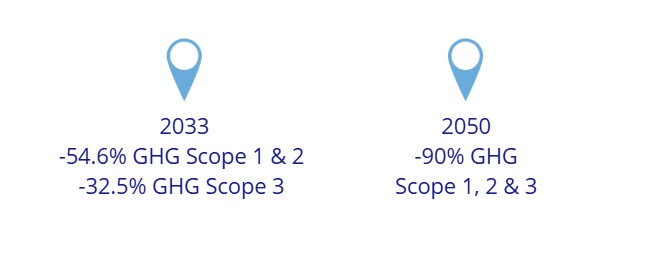 Progress against these milestones will be reported annually through SWM’s ESG Report and disclosed in line with SBTi transparency guidelines. As an independent company with dedicated resources and strategic agility, SWM is not waiting for sector-wide mandates – we are setting the pace.